Why High-Quality Luggage Hardware Breaks Easily and How to Prevent It
Hardware parts are vital components in luggage manufacture, not only with adornment but also, more important, to secure the construction and use safety. But even the best quality hardware may be subject to breakage with use. The reason for this can be traced to a variety of sources, including material choice, structural design, testing methodologies and usage procedures. In this paper, the reasons for hardware damage are systematically explained from the following five aspects: environment friendliness and density of materials, thickness at joints, tension test force analysis, relation between characteristic strength of individual components and thickness of components and load using conditions. It also gives preventive measures as related.
Is the material environmentally friendly European standard material? Is the density sufficient?
The quality of hardware materials directly determines their strength and durability. While many brands claim to use eco-friendly European standard materials, whether they actually meet the standards and whether the material density is sufficient are questions that require thorough investigation.
The Significance and Standards of Eco-Compliant European Materials
Europe standard environmental friendly materials namely reffers to EU REACH regulation or RoHS directive that requires low toxicity,low pollution and recycle. For example, with zinc alloys, stainless steel or engineering plastics the amount of harmful substances such as lead and cadmium is to be limited. This substance is not only eco-friendly, but also adds to the stability of your hardware. That does produce an earth-friendly panel; it just doesn’t make a strong one. When structure is not dense enough, fracture problems may result even though environmental requirements are met.
Relationship Between Material Density and Strength
The measurement of density is an effective way to identify the compactness of a material which affects its strength and hardness. For zinc alloys the density of high-quality material reaches 6.6–6.7 g/cm³, while low grade materials will have values as low as 6.3 g/cm³ -sometimes even less. Heterogeneities Low density materials may contain internal voids or impurities that concentrate stress under the applied load and produce failure. Some manufacturers go overboard with recycled material to reduce costs, sacrificing density (and strength).
How to Assess Material Quality
Consumers can make an initial judgment of density by observing whether the hardware surface is smooth and free of burrs or bubbles. Brands should provide material inspection reports specifying density and environmental standards. The key to preventing breakage lies in selecting high-density materials that meet environmental standards and controlling supplier quality at the source.
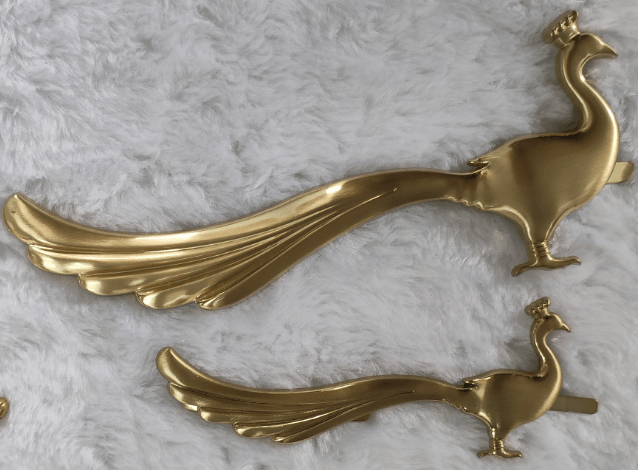
In summary, material quality forms the foundation of hardware rigidity. Environmental friendliness and density must be prioritized equally—neither can be compromised.
Does the thickness at connection points meet tensile strength requirements?
Connection points of hardware components—such as the junction between buckles and cases, or the pivot points of adjustment buckles—are critical stress-bearing areas. Insufficient thickness can easily lead to fracture due to stress concentration.
Principles of Thickness Design
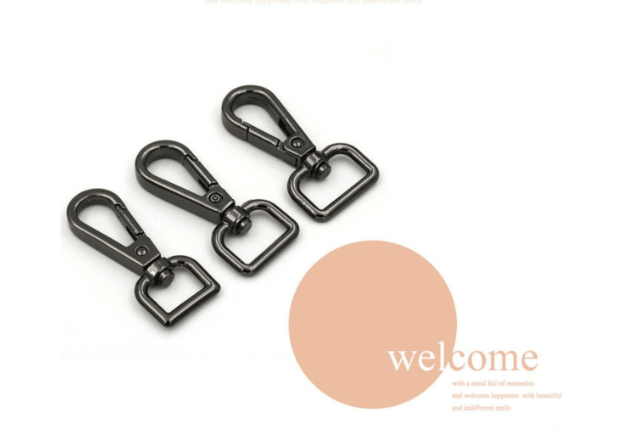
The connecting point must also consider the thickness, should be calculated based on the actual tensile force. For example, the thickness of the connecting part between luggage handles and the case body not less than 2.5mm, and the shaft thick-ness of hook fasteners is no less than 1.5mm. Too little thickness leads to parts with low section modulus; they are inherently easily bent or broken under load.
Thickness and Stress Distribution
Finite element analysis reveals that fillet design and thickness variations at connection points influence stress distribution. Abrupt thickness changes or sharp edges concentrate stress locally, significantly increasing fracture risk. Therefore, high-quality hardware should employ tapered thicknesses and curved transitions to disperse stress.
Case Study and Improvement Strategy
A mass of luggage buckles from a particular kind underwent group fractures at the connecting points. Upon examination it was found that the effective thickness was only 1.0 mm as against the designed value of 1.8mm. With the thickening and structure optimization, the rate of fracture was reduced by 80 %. This indicates that the thickness layout should be strictly designed according to engineering regulation and in process must be fully detected.
To prevent fractures at connection points, stress conditions must be simulated during the design phase, and production must ensure compliance with thickness requirements.
Has it undergone tensile testing?
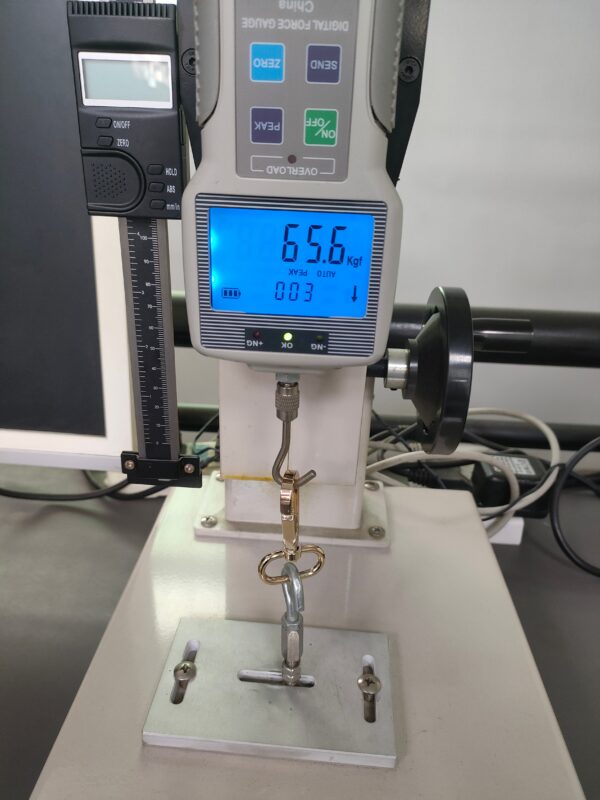
Tensile test classification is main method forhardware testing strength. It is able to predict possible failure risks by simulating the applied forces in use.
Standards and Methods for Tensile Testing
High-quality hardware should undergo multiple tensile tests, including static tensile and dynamic fatigue testing. For example:
- Tensile (Static) Test: Tension the specimen at a steady rate of increase in load until failure and note the maximum force. E.g., to meet the requirement for a closure with a hook buckle, it must be capable of resisting tensile traction loads of 90N or more
- Dynamic Fatigue Test: Imitate using bear over and over. For example, an adjustable buckle must withstand 5000 open/close cycles without any deformation or breakage. Test environment should simulate to actual conditions with real temperature and humidity changes..
The Importance of Test Parameters
Test results are affected by loading rate, fixture design and number of samples. For example, too rapid loading can lead to overestimation of strength or not enough samples may inadequately represent the quality of an entire lot. Brands should operate according to international best practices (including ASTM F2054 and QB/T 5243) in order to guarantee pin controlled, scientific tests.
Testing and Failure Prevention
Tensile testing does more than validate the strength of the product, it also delivers insights needed to improve designs and make production more efficient. This enables the modification of materials or structures if problems are detected during testing, to avoid mass production disasters. When choosing products, consumers should check whether they have been tested and confirmed by some certifications below. In conclusion, Tensile Test is an very important step to keep your HW durable by all means.
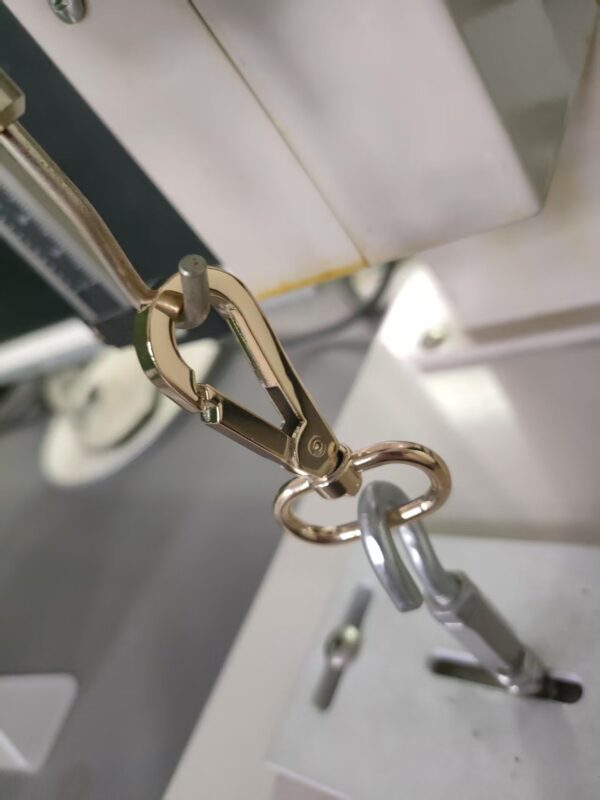
In summary, tensile testing is a critical safeguard for hardware durability and must be strictly enforced.
Thickness correlated with specific tensile strength for spring coils, hook buckles, square buckles and adjustable buckles
Different hardware parts have different functions, and the relationship between their tensile strength and thickness must be analyzed in detail. Here are the parameters needed for common accessories:
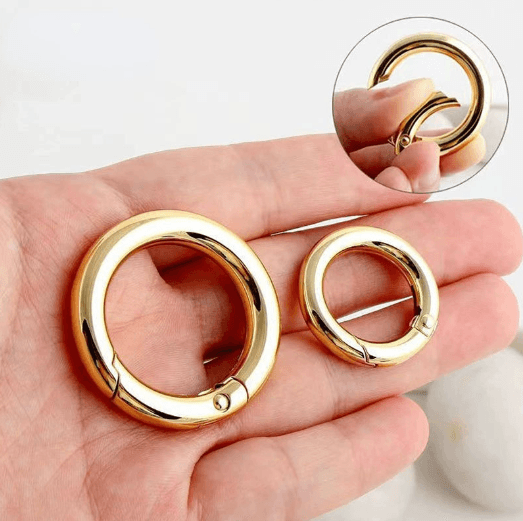
Spring Ring
- Spring coils are commonly used in backpack straps or luggage handles to provide elastic restoring force. Their tensile strength depends on wire diameter and coil count:
- For every 0.1mm increase in wire diameter, tensile strength increases by approximately 15%.
- A higher number of coils increases the elastic range, but excessive coils may reduce fatigue life.
For example, high-quality spring coils require a wire diameter ≥0.8mm and a tensile strength of no less than 50N.
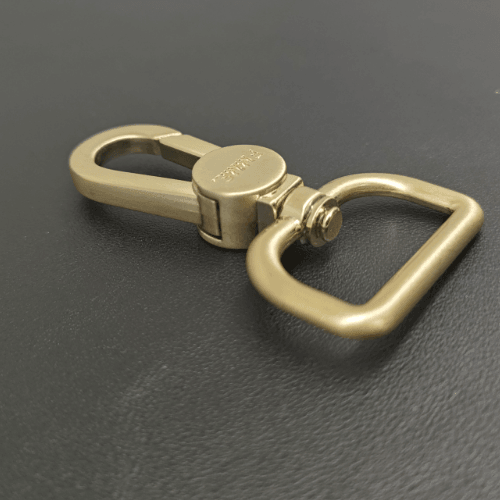
Hook Buckle
- Hook buckles connect shoulder straps or bag bodies, with strength dependent on hook arm thickness and material:
- Thinckening from 1.2 to 1.5mm streng.
- Stainless steel hook buckles exceed zinc alloy strength by over 20%.
Design testing must prioritize the buckle’s opening area to prevent deformation or fracture.
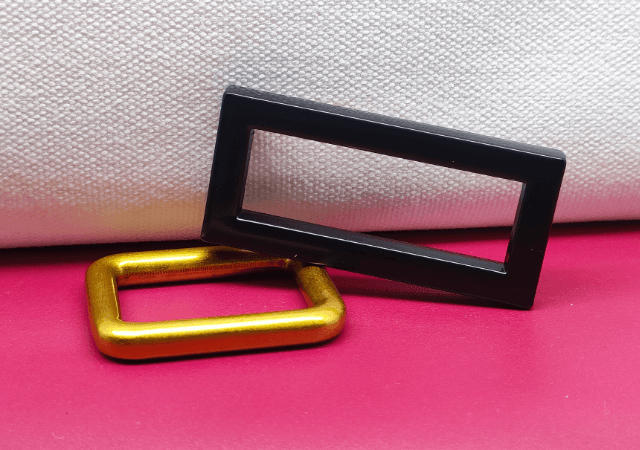
Square Buckle
- Square buckles are commonly used for securing or decorating luggage, with stress concentrated at the corners:
- Corner parts to have thickness ≧= 1.8 mm with curved transitions.
- Tensile strength will not be less than 80N and dynamic testing should survive 3000 cycles.
Adjustment Buckle
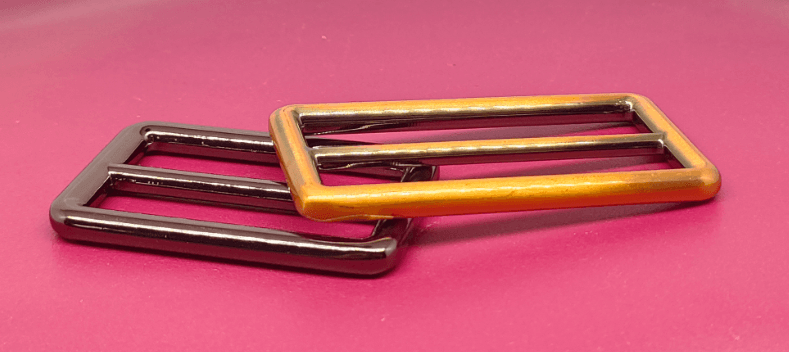
The strap length, which is determined by the shaft and teeth of the adjustment buckle:
- The shaft thickness should be not less than 1.5mm, and the tooth height should be no less than 0.8mm.
- Tensile stress shall be >60N, and no any break at after 3X adjustable.
- These components can be much stronger by designing the right thickness and structure, no break even.
Whether luggage hardware exceeds rated load during use
Even if the hardware itself is of high quality, exceeding the rated load during use may still cause breakage. Therefore, users must understand load limits and use the hardware correctly.
The Significance of Rated Load
The highest force that a piece of hardware can sustain without risk over long periods of time is known as the rated load. For example, if a carabiner is put to forces greater than its rated load of 50N, it may distort or break. To avoid user abuse, brands should make load data explicit in product instructions.
Consequences of Overloading
Metal fatigue is accelerated by overloading, which leads to the spread of microcracks into macroscopic fractures. For example, the handle connection may break instantaneously when luggage is overloaded. Furthermore, dynamic loads (such running or impacts) raise stress levels above those found in static tests.
Preventing Overloading
Users should spread their belongings evenly and respect the weight restrictions indicated on their bags. Manufacturers can optimise their designs by adding reinforcement ribs, adding load warning placards, or improving structural redundancy.
Ultimately, proper usage remains the final line of defense against breakage.
Conclusion
High-quality luggage hardware breakdown affects every step of the process, from design and materials to testing and use. In order to prevent breakage, it is necessary to make sure that the materials are dense enough and environmentally friendly from the start, optimise the thickness of the connections to distribute stress, verify strength through rigorous tensile testing, refine the relationship between thickness and strength for various components, and advise users not to overload. The longevity and security of luggage gear can only be optimised by brands and consumers working together. Future developments in materials science and testing techniques should result in luggage gear that performs better and lasts longer.