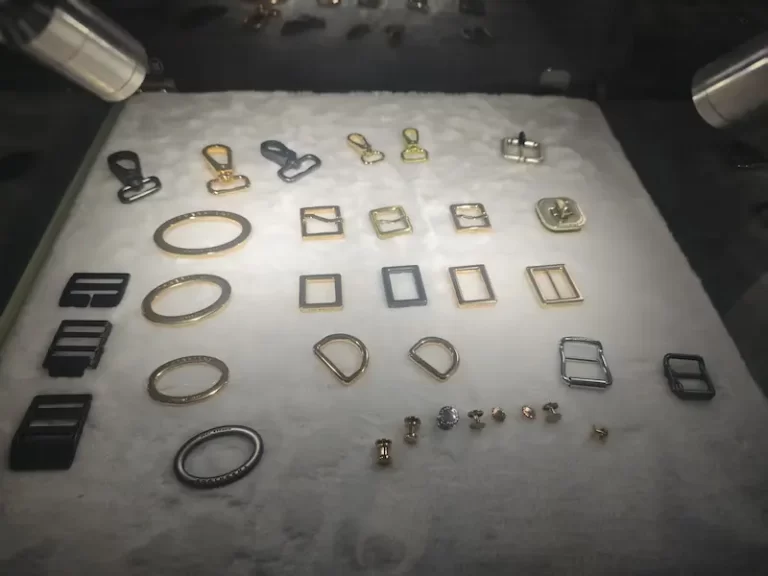
Stamping Process Flow for Bag snap hook
A small lobster clasp may seem simple, but its production involves considerable industrial technology. In many countries, independently manufacturing these small lobster clasps is quite challenging, leading to heavy reliance on imports. Let’s examine the stamping process for Bag snap hook:

An Overview of the Stamping Process: Why Choose Stamping?
Lobster clasps are primarily manufactured using the stamping process, rather than casting or forging. This is because the stamping process offers unrivalled advantages in high-volume production: high production efficiency, excellent material utilisation and good dimensional consistency. For lobster clasps, which are small in size but in high demand, stamping is the optimal solution that balances technical feasibility with cost-effectiveness.
The core principle of the stamping process is as follows: a metal strip (coil) is fed into a press, where a set of progressive dies performs a series of operations—including punching, trimming, forming and blanking—during continuous feeding. As described in a technical document on the stamping process for lobster clasps, this process employs a composite die solution, integrating multiple operations into a single set of dies and following the traditional sequence of ‘from simple to complex’: first punching the inner hole, then forming the outer shape, and finally completing the final forming. Specifically, the sequence of stamping operations follows the basic logic of ‘blanking – punching – cutting – forming – trimming – finishing’.
Mould Design: The ‘Brain’ of the Stamping Process
During a single left-to-right feed cycle, the strip passes through the following stations:
- Station 1: Blank stroke
- Station 2: Embossing
- Station 3: Punching
- Station 4: Trimming
- Station 5: Punching
- Station 6: Blank stroke
- Station 7: Blank stroke
- Station 8: Punching
- Station 9: No-operation
- Station 10: Forming
- Station 11: No-operation
- Station 12: Punching
- Station 13: Notching and Downward Bending
- Station 14: Downward Bending
- Station 15: Forming
- Station 16: No-operation
- Station 17: No-operation
- Station 18: Blanking.
For the stamping process of lobster clips, factors such as material utilization rate, forming quality, and production efficiency must be considered. Based on material thickness and product structural complexity, the following sequence of operations is adopted: blanking followed by punching, then blanking out, forming, trimming, and finally finishing. During stamping, calculating the blanking clearance is critical and can be determined using the following formula.
Key Technical Parameters and Challenges in the Stamping Process
Manufacturers must carefully control key process parameters during the stamping process of lobster clasps for luggage and bags
| Parameter categories | Key parameters | Key Control Points |
| Die-cutting parameters | Punching clearance, punching speed | If the clearance is too large, burrs will form; if it is too small, wear will be accelerated. |
| Bending parameters | Bend radius, springback compensation angle | Must be set precisely according to the thickness and properties of the material |
| Lubrication parameters | Types and quantities of lubricating oil | Reduce friction and extend mould life |
| Feeding parameters | Feed step accuracy | The accumulation of errors can lead to deviations in the final dimensions |
Key technical challenges currently facing the industry:
Inconsistent mould precision: This affects product dimensional consistency and must be addressed by optimising the precision of mould design and utilising finite element analysis for validation
Short mould service life: Rapid wear of punch and die components necessitates the use of powder metallurgy high-speed steel or cemented carbide materials, supplemented by PVD/CVD coatings
Poor batch consistency: Strict control of process parameters is required, coupled with in-line measurement and monitoring
Difficulty in controlling springback: Requires the use of CAE pre-analysis and mould compensation design
The Structural Components of a Lobster Clasp
Before delving into the manufacturing process, it is necessary to understand the physical composition of a lobster clasp. A complete lobster clasp typically consists of the following components:
Clasp body (shell): The main part of the lobster clasp, shaped like a ‘lobster claw’, with an opening on one side.
Inner clasp (movable part/push button): A component that engages with the clasp body and, when pressed, opens the opening in the clasp body.
Torsion spring: Provides the return force that allows the inner clasp to automatically reset and close once released.
Pivot pin: This connects the inner clasp to the clasp body via a hinge, with the torsion spring fitted around the pivot pin.
The stamping process primarily outputs the clasp body and inner clasp, specialised spring-making machinery usually manufactures the torsion spring, and turning or cold heading produces the pivot pin. This article will focus specifically on the stamping manufacturing process for the clasp body and inner clasp.
Where:
Cutting clearance Z (mm)
Coefficient k (0.005–0.035)
Material thickness s (mm)
Material shear strength τb (MPa)
Stainless steel is commonly used for lobster clips
with stamping parameters selected as shown in the table below
| Process | Stamping Force (kN) | Clearance Coefficient k | Die Material | Lubrication Condition |
|---|---|---|---|---|
| Blanking | 180-220 | 0.025 | Cr12MoV | Mineral Oil |
| Punching | 80-120 | 0.020 | SKD11 | Mineral Oil + Additives |
| Blank Separation | 150-190 | 0.025 | Cr12MoV | Mineral Oil |
| Sizing | 240-280 | – | SKH51 | Synthetic Lubricating Oil |
| Trimming | 60-90 | 0.015 | SKD11 | Mineral Oil |
| Finishing | 70-100 | 0.010 | SKH51 | Precision Lubricating Oil |
Post-Stamping Processing and Quality Control
Post-processing of Stamped Parts
Lobster clasp components for luggage, following stamping and forming, usually require further processing before they can become finished products that meet the required standards.
Surface treatment
Electroplating: Gold, nickel, bronze, chrome, antique bronze, antique silver, etc., to achieve a decorative finish and corrosion resistance
Coating: Application of anti-oxidation paint to form a dense protective layer
Post-processing
Grinding and polishing: To remove burrs and improve surface finish
Resin casting and stone inlay: To enhance the decorative effect
Companies in this sector typically have die-casting, cold stamping, threading, grinding and polishing, potting, stone bonding, assembly, quality control and packaging, and surface treatment and electroplating departments, forming a complete production chain.
Automatic Sorting Technology for Stamped Parts Scrap
In the post-processing of die-cast luggage fasteners, a stamping press removes the sprues from the cast blanks by punching. Patented technology has enabled a fully automated sorting and stamping solution.
Automatic gripping manipulators: The pick-up manipulator handles the retrieval and placement of stamped parts, whilst the unloading manipulator simultaneously processes post-stamping scrap, replacing manual loading and unloading and thereby reducing safety risks and labour costs
Secondary continuous stamping unit: The first stamping operation removes the sprue, whilst the second stamping operation processes the remaining scrap; the interval between the two stamping operations is merely 0.5–0.8 seconds, significantly reducing stamping time
Tilting Sorting Assembly: A cylinder-driven tilting sorting plate directs scrap and finished parts into separate collection bins, eliminating the need for manual sorting.
This technological approach represents the evolution of post-stamping processing from ‘manual intervention’ to ‘fully automated separation’.
In summary, a seemingly simple bag lobster snap involves approximately 18 distinct stamping process steps. The intricate details demand high precision, making independent production of such bag hardware components unfeasible without substantial industrial expertise. So why does OYC offer competitive pricing for its bag lobster clips? This advantage stems entirely from China’s robust supply chain, deep industrial expertise, and economies of scale, which collectively drive down marginal costs.