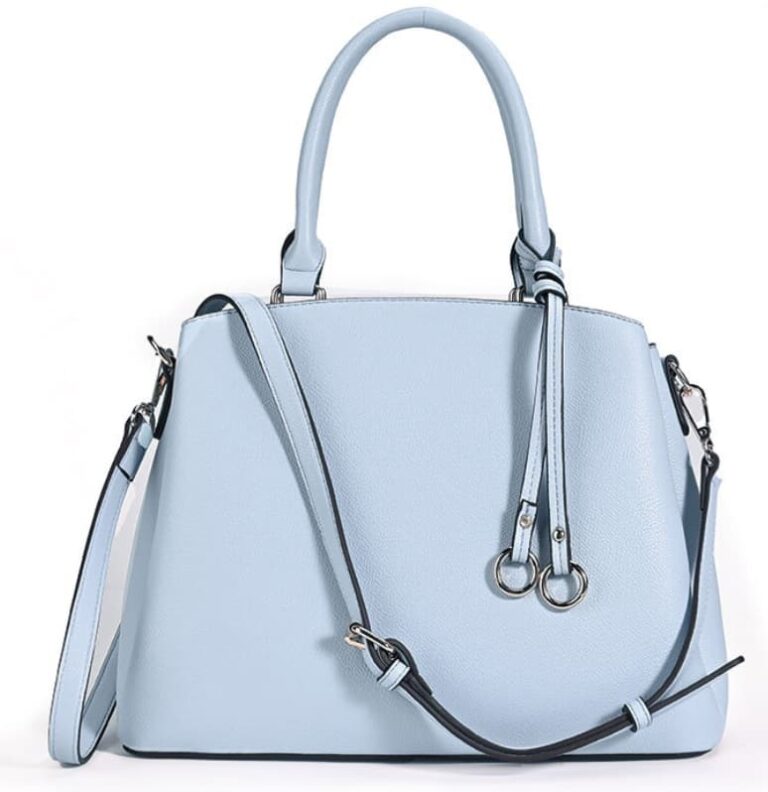
What are the metal things on bags called?
The soul of a handbag is often hidden in those few unassuming metal fittings. There is an old saying in the industry: a luggage hardware serves as the finishing touch—it is the soul of the bag, and its aesthetic appeal and value depend largely on the quality of these fittings. From an exquisite branded logo plaque to the D-ring connecting the shoulder strap, right through to the protective studs on the base—these metal components collectively form the handbag’s functional system and aesthetic language.
However, faced with a bewildering array of hardware terms, many people often struggle to distinguish between ‘studs’ and ‘mushroom studs’, or to understand where ‘dog clasps’ and ‘lobster clasps’ are used. This article will systematically organise the common metal components found on handbags, moving from general terms to specific categories, and break down their names, functions and characteristics one by one.
Their unified name of Luggage hardware
In the context of the industry, all metal components on handbags are collectively referred to as ‘leather goods hardware’ (or ‘leather goods fittings’ for short).
This term encompasses the various small metal fittings used in handbags, rucksacks and all types of luggage. Most of these are not end consumer products, but rather ancillary products or semi-finished goods for industrial manufacturing, serving the assembly and production of handbags. Only a small proportion, such as decorative bag chains and pendants, reach customers directly as finished decorative items
Luggage hardware varies widely in type and falls into different categories depending on the criteria used
By material
These materials fall into iron, copper, aluminium, zinc alloys, stainless steel and so on. Zinc alloys lead in usage thanks to their die-casting qualities and moderate cost; copper fittings (especially brass) serve high-end products with their warm feel and corrosion resistance; stainless steel offers high strength and rust resistance, suiting heavy-load applications
By colour (plating process)
these can be categorised as white (i.e. silver), gold, light gold, gunmetal (black nickel), antique bronze, brushed antique bronze, chrome, pearl nickel and rose gold, amongst others. Different plating colours lend hardware fittings distinct visual characteristics—light gold exudes elegance, gunmetal conveys a cool, austere look, and patinated bronze has a vintage feel.
By process
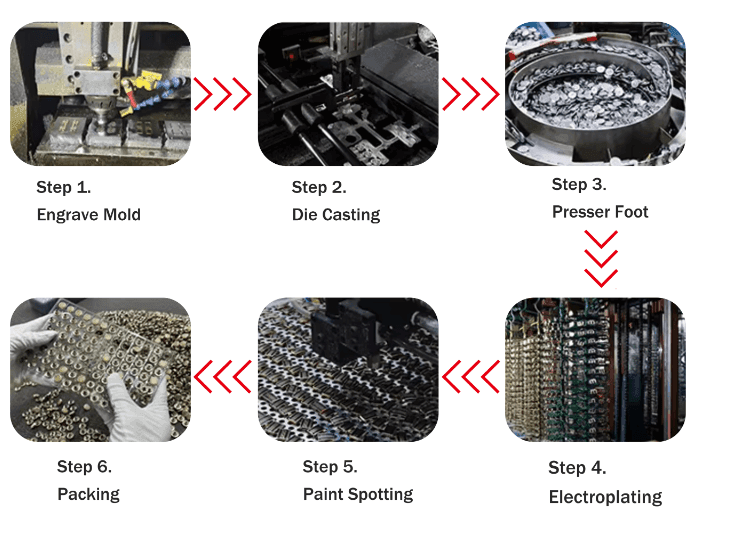
We further categorise electroplating methods into barrel plating, rack plating, continuous plating, electroplating and vacuum plating, amongst others; these methods significantly affect both quality and cost. For example, vacuum plating produces a more uniform and rich colour, but is also relatively more expensive.
From a functional perspective, we can broadly categorise luggage hardware fittings into five main types: fasteners (D-rings, dog clips, hook fasteners, etc.), closures (latches, magnetic fasteners, zip pullers, etc.), securing elements (rivets, studs, eyelets, etc.), protective components (foot studs, corner protectors, etc.) and decorative elements (brand labels, decorative chains, decorative studs, etc.)We shall examine each of these in turn below.
Fasteners: A Wide Variety of ‘Connecting Artistry’
Fasteners constitute the most diverse and functionally varied category of handbag hardware. They are responsible for connecting, securing and opening and closing the bag, and are key components in its structure. Based on their function, we can broadly divide fasteners into two main categories: connecting fasteners and closing fasteners
Connecting Fittings of Luggage hardware
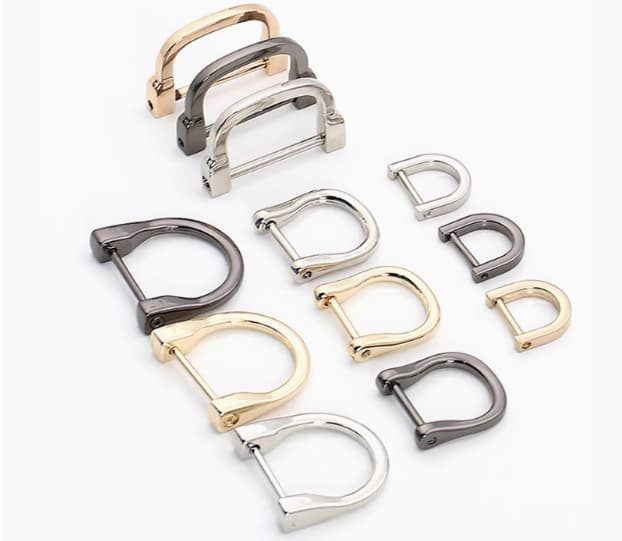
D-ring (D-shaped ring)
The D-ring takes its name from its resemblance to the letter ‘D’ and is one of the most common connecting fittings found on handbags. It is generally made from one of three materials: copper, iron or zinc alloy. D-rings made from copper or iron usually have a break in the ring (unless welded), whilst those made from zinc alloy do not have this break and are therefore more robust. D-rings find wide use in manufacturing luggage and handbag straps, and they often sit on either side of the bag or at the handle bases to attach detachable shoulder straps or carrying straps. In load-bearing areas, the wall thickness and choice of material for the D-ring directly affect the safety of the handbag—D-rings that are too thin or made of materials that are too brittle may deform or even break when under load.
Dog clip
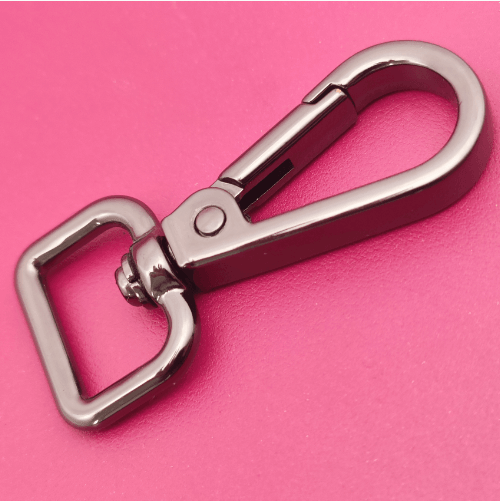
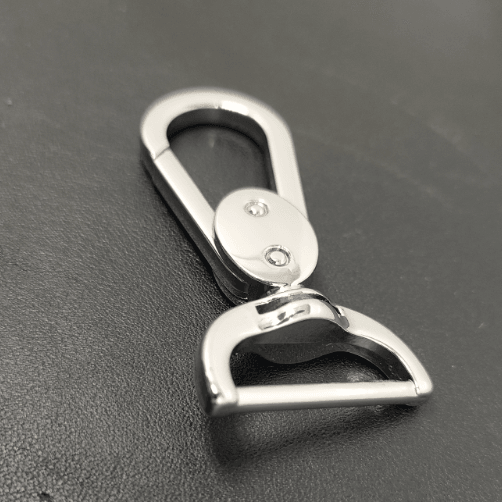
A dog clip is a metal fastener with a hook, typically die-cast from a zinc alloy. It mainly serves at the end of straps or lanyards, allowing users to easily secure the strap to a D-ring or other circular fastener. Put simply, a dog clip acts as a link between the ‘strap’ and the ‘D-ring’. The key to the design of a dog clip lies in the elasticity of the hook and the strength of its grip—if it is too tight, it is difficult to fasten; if it is too loose, it is prone to coming undone.
Lobster clasp
The lobster clasp takes its name from its resemblance to a lobster’s claw and is a type of hook-and-eye fastener with a spring-loaded opening. It is easier to use than a standard dog clasp—simply press the spring plate lightly to open the clasp, and it closes automatically when you release it. Lobster clasps commonly fasten the ends of necklaces, key rings and handbag straps, and they enjoy wide popularity due to their smooth operation and elegant design
Closure Mechanisms of bag hardware
1. Lock Clasps
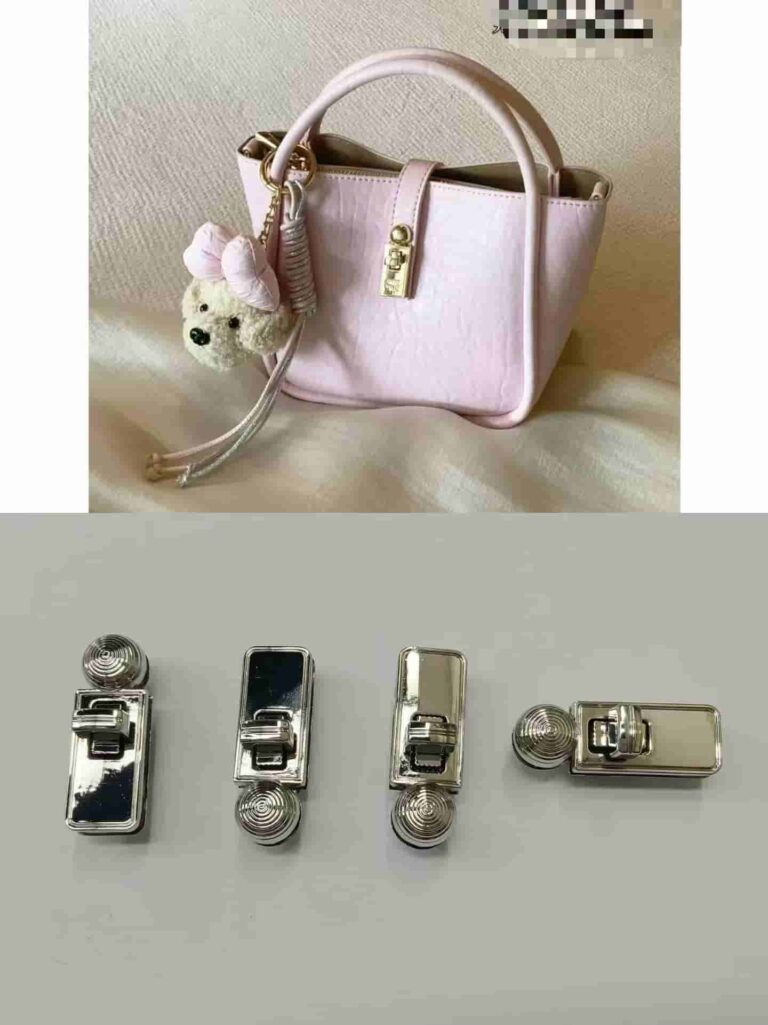
Lock clasps are the core components of a handbag’s closure system, primarily serving a protective and security function. There are various types, including:
- Spring lock: Secures the bag flap via an interlocking spring mechanism; it can be unlocked by pressing both sides or flicking a switch.
- Slide clasp: The male clasp is inserted into the slot of the female clasp to secure the bag; commonly found on vintage-style handbags.
- S-shaped clasp: The clasp body features an S-shaped curve, combining both functionality and decorative appeal.
The precision and material of the clasp directly affect the perceived quality and safety of a handbag. High-end handbag clasps usually feature solid brass casting and fine polishing; when they open and close, they emit a crisp ‘click’—a sound that itself provides auditory proof of their quality
Magnetic fasteners (magnetic snaps)
Magnetic fasteners use built-in magnetism to secure bag flaps or opening edges, offering a convenient solution for temporary closure without the need for a locking mechanism. Users find them easy to operate, and they open and close smoothly, making them widely used on flap bags, tote bags and wallets. Designers must match the magnetic force strength to the weight of the bag flap—if they set it too tight, users will struggle to open and close the bag; if too loose, the flap may spring open on its own. A good magnetic fastener produces a distinct ‘snap’ when closing, offering a crisp and precise feel.
Monk’s Head (Pacifier Stud)
This is a metal fitting featuring a rounded, raised head, typically used in conjunction with the holes in a leather strap. To fasten it, simply slip the leather strap over the raised part of the monk’s head. It is commonly found on handbags with a vintage or minimalist design; it is simple to use and has a distinctive style. The name ‘monk’s head’ derives from the rounded shape of its head, which bears a striking resemblance to a baby’s dummy.
Snap Fastener
A snap fastener comprises two parts—a male and a female component—that lock together when pressed to secure the fastening. Manufacturers often use it on the openings of inner pockets in bags or small storage pouches, and they value it for its simple structure, low cost, and suitability for mass production
Chains: The Shift from Practicality to Ornamentation
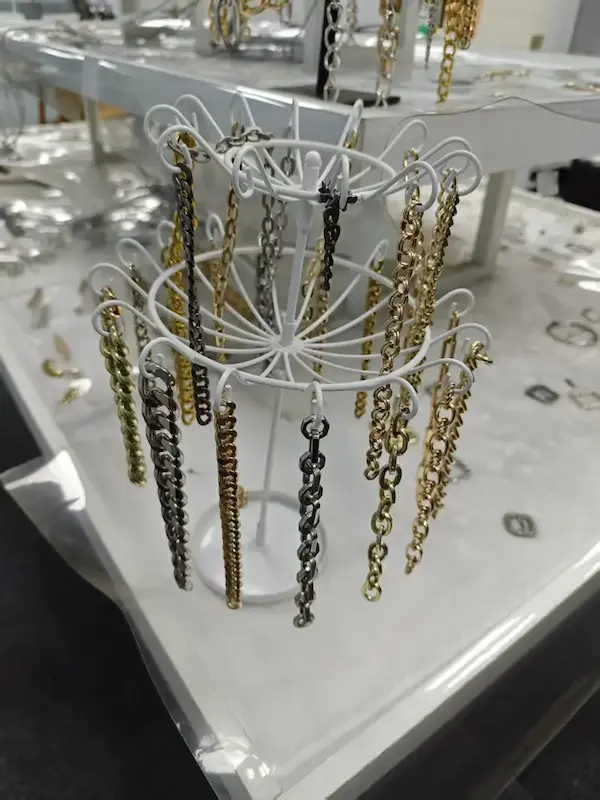
Among Luggage hardware , chains hold a special place—they can serve both as functional components (shoulder straps) and purely as decorative elements.
As shoulder straps: Metal chains are particularly common on evening bags and chain-strap bags. They appear more refined and opulent than leather straps, making them ideal for pairing with elegant evening gowns for banquets or formal occasions. Manufacturers typically make chains from materials such as copper, iron or stainless steel, and electroplate their surfaces to produce finishes such as gold, silver or gunmetal. To enhance comfort when worn over the shoulder, many chain bags feature a section of leather threaded through the centre of the chain, or designers craft the chain in a flat, ‘braided’ style to distribute pressure across the shoulder
As decoration: Short chains are also used as decorative pendants on handbags, or hung from the side of a bag as an embellishment. Some designs feature small tags or key rings attached to the ends of the chains, adding depth and interest.
Types of chains: In terms of craftsmanship, chains come in a variety of styles, including beaded chains, twisted chains (side chains), O-ring chains, snake chains, box chains and swastika chains. Different types of chains convey distinct styles—beaded chains present a rounded and delicate look, making them suitable for evening bags; twisted chains project a rugged and bold image, ideal for biker bags or unisex handbags; O-ring chains offer a classic and versatile appeal, giving them the widest range of applications
Key considerations: A chain’s load-bearing capacity depends on the welding method and the thickness of the material used for the links. Chains with poor welds are prone to breaking under weight, so high-quality handbags typically feature fully welded chains that have undergone tensile testing.
Rivet: A Dual Role in Function and Decoration
A rivet is a metal fitting with a shank that manufacturers secure to leather or fabric by riveting. It serves two purposes: structural reinforcement and decorative embellishment.
Structural Reinforcement
At stress points on a handbag—such as the base of the handles or the attachment points for shoulder straps—manufacturers use rivets to reinforce the joints between the leather or webbing, preventing tearing. They typically design these functional rivets to be relatively understated, matching the colour of the bag’s other hardware
Decorative Accents
Many handbags feature studs as decorative elements on the surface or at the corners. By arranging them in patterns (such as brand logos or geometric designs) or using uniquely shaped studs (such as star-shaped or heart-shaped ones), they add a sense of detail and individuality to the handbag.
Classification of Rivets
They fall into round-head, flat-head, mushroom-head and shaped rivets by head shape; they come primarily in copper, iron, aluminium, stainless steel and alloys by material; and they split into two main surface-finish categories: barrel plating (environmentally friendly nickel, antique silver, antique bronze, etc.) and electroplating (pure gold, light gold, antique blue brushed finish, etc.)
Installation method
Rivets require base washers (also known as ‘spacers’) to work properly. During installation, you pass the rivet shank through the leather, slip the washer over the shank from the other side, and then use a riveting tool to flatten or flare the shank, thereby securing the rivet in place This installation method means that once rivets are in place, they are difficult to remove; consequently, positioning accuracy during the production process is of the utmost importance.
These differ from similar products—mushroom-head pins, hollow pins, and rivets—in that mushroom-head pins have a domed head and a fuller shape, finding common use in clothing and footwear; hollow pins contain a centre hole for threading a cord; rivets have a solid shank and serve mainly for fastening and decoration
Logo Fittings: A Silent Calling Card
Logo fittings (also known as badge fittings or logo hardware) serve as a handbag’s ‘identity marker’ and represent the most direct visual dialogue between the brand and the consumer.
Brand Recognition
The most fundamental and core function of branded hardware is brand recognition. An exquisitely crafted metal badge can convey brand information in an instant. When consumers see the interlocking double Gs (Gucci) or the equestrian rider emblem (Burberry), they can instantly recognise the brand without the need for any text.
A Mark of Quality
Consumers often judge the quality of a bag by the details of its logo—are the edges smooth? Is the plating colour even? Is the lettering clear and sharp? These details directly reflect the precision of the moulds, the plating process and the standard of quality control.
Manufacturing Processes
Logo hardware is primarily manufactured using the following processes:
- Die-casting: A process in which molten metal is injected into a mould to form the shape; suitable for logos with complex three-dimensional designs.
- Stamping: A process in which a die is used to cut shapes out of sheet metal; suitable for flat or shallow relief logos.
- Etching: A process in which text or patterns are formed on a metal surface through chemical corrosion; suitable for fine typefaces.
- Enamel inlay: A process in which coloured enamel is applied to recesses in the metal to enhance the colour depth.
Design Trends
In recent years, brand hardware design has shown two parallel trends: firstly, the ‘visible logo’ has returned, with large metal badges serving as a means of self-expression for younger consumers; and secondly, the ‘invisible logo’ has risen, as brands subtly incorporate their identifiers through embossing or minimalist metal plates to pursue understated luxury.
Installation Methods
Branded metal fittings are typically attached to the bag body using one of three methods: screw fastening, riveting or adhesive bonding. High-end handbags often employ screw fastening, which facilitates repair and replacement; fast-fashion products, on the other hand, tend to use adhesive bonding, which is lower in cost but slightly less durable.
Zips and Their Fittings
Zips rank among the most commonly used fastening mechanisms for handbags, and their associated metal fittings comprise at least two separate components: the slider and the pull tab
Slider
We fit this metal component over the zip teeth and use it to slide the zip open and closed. We primarily make sliders from three materials: zinc alloy, copper, and aluminium alloy. Zinc alloy sliders offer moderate pricing and high malleability, so we use them most widely. Copper sliders give a more luxurious feel, so we often use them in luxury handbags. Aluminium alloy sliders are lighter, so we prefer them for outdoor and sports bags.
When you look at zip pulls, one key feature is the retention mechanism. Some come with a self-locking design—once you let go of the pull, it locks the chain automatically so it won’t slip open. Others don’t have that feature, so you have to manually make sure the chain stays in place High-end handbags almost universally feature self-locking zip pulls to enhance security and the user experience.
Pull Tab (Pull Tab / Zipper Pull)
You fit this piece to the top of a zip so you can grip it with your fingers to open and close it. Even though it’s small, you’ll find the pull tab is one of the most touched metal parts on a handbag. You can group pull tabs into different types based on their design:
Flat Pull Tab: The simplest, flat-shaped pull tab, commonly found on totes and rucksacks.
Drawstring pull: A casual-style pull featuring leather or braided cord threaded through the pull head’s hole, tied in a knot or fitted with a metal finial.
Shaped pull: Designed in the shape of a brand logo or other distinctive form, serving a decorative function as well.
Extended pull: An elongated pull designed for ease of use whilst wearing gloves, commonly found on winter handbags or travel bags.
Zip teeth (Chain)
Although manufacturers may use nylon, plastic-steel, or metal for zip teeth—the three most common types—they still widely employ metal zip teeth in high-end handbags. Metal zip teeth (copper or stainless steel) are more robust and glide more smoothly than nylon or plastic-steel teeth; they also have a more luxurious appearance, and are naturally considerably more expensive.
Zipper Stoppers
Metal fittings fitted at both ends of the zip to prevent the slider from slipping out. We divide these into upper stoppers (at the top) and lower stoppers (at the bottom). High-quality stoppers can effectively extend the lifespan of the zip.
Key considerations: When selecting zip hardware, it is important to take into account the frequency of use, load-bearing requirements and stylistic considerations. For the main opening of a daily commuter bag, you should go with metal-tooth zips—they hold up better to constant opening and closing. For inner pockets, you can use nylon or plastic zips instead to save on cost and weight. Furthermore, the size of the zip pull must match the zip tooth type—if the pull is too large, the zip will slide loosely; if it is too small, it will jam and fail to slide smoothly.
Selecting and Coordinating Hardware Fittings
Having familiarised yourself with the names and functions of various hardware fittings, it is also important to understand the principles governing their selection and coordination in handbag design:
Principle of Material Consistency
Manufacturers should make all hardware fittings on a single handbag from the same material wherever possible, so that the plating colour and texture remain consistent throughout. Mixing hardware made from different materials can lead to colour discrepancies, which detract from the overall sense of sophistication.
Principle of Colour Coordination:
The plating colour of the hardware must complement the body colour and design style of the handbag. If you’re working with warm-toned leathers like caramel or burgundy, you’ll want to pair them with gold or light gold hardware. For cool-toned shades such as black or grey, go with silver or gunmetal. And if you’re going for a vintage look, choose antique bronze or an aged, distressed finish
Principle of Strength Matching
Designers must choose sufficiently thick and robust materials for hardware components in load-bearing areas—such as D-rings, hook fastenings, and horseshoe clasps—and they should never compromise strength for aesthetics. Put simply, they should use copper or thick zinc alloy for high-stress areas, while ordinary zinc alloy will suffice for small decorative pieces.
Principle of Repairability
The design of high-end handbags should, as far as possible, take into account the repairability of the hardware – for example, using screws rather than rivets to secure logo plaques, to facilitate future replacement; removable shoulder strap fastenings also make it easier for users to replace components themselves.
Conclusion
The metal components on a handbag—ranging from the general term ‘leather goods hardware’ to specific items such as D-rings, dog clips, lobster clasps, latches, magnetic fasteners, studs, bag clips, brand tags, zip pullers, foot studs and eyelets—each name corresponds to a specific functional purpose and aesthetic value. They are not merely the ‘joints’ that connect the leather and secure the structure; they are also a direct reflection of a handbag’s quality and style.
The next time you pick up a handbag, do take a moment to observe those unobtrusive metal components—is the D-ring smooth and free of burrs? Does the clasp open and close with a crisp, smooth action? Does the zip glide silently and effortlessly? Is the typeface on the brand label clear and sharp? Are the studs arranged in a neat, uniform pattern? These details are the most intuitive indicators of a handbag’s craftsmanship. And knowing their names is the first step towards understanding these ‘little things’. Familiarising yourself with these terms will not only give you greater confidence when selecting and evaluating handbags, but will also enable you to communicate more precisely with designers, artisans or sales staff.