The Difference Between Zinc Alloy & Iron Bag Hardware
Let’s be honest: when people pick up a handbag or a backpack, they don’t just check the bag hardware – they feel the buckles, the clasps, and the zippers. And that small hardware? It either says “premium” or “cheap” in just a few seconds.
So if you’re designing bags or sourcing for a brand, choosing between zinc alloy and iron for your bag hardware isn’t just a technical checkbox.
It’s actually a branding decision.
Both materials are super common in bag hardware. But trust me – they behave very differently when it comes to weight, rust, and how easy they are to make.
So let me walk you through the real differences. By the end, you’ll know exactly which one fits your next production run.
1.What Are They Made Of & How Are They Made?
To understand the difference between the two, we must first delve into their microscopic world. Although zinc alloys and iron are both metals, their intrinsic ‘genetic makeup’ is entirely different, and this determines all their subsequent behaviour.
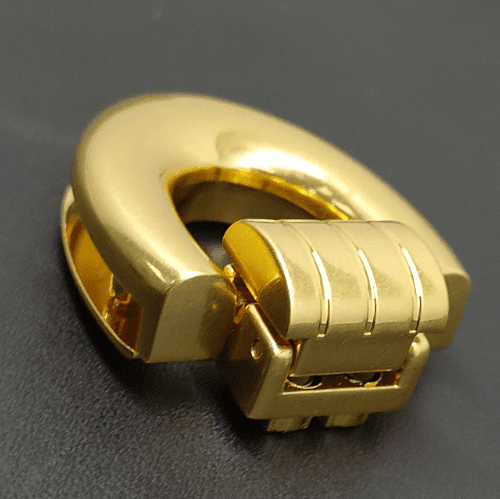
Zinc Alloys: The Darling of Die-Casting
The zinc alloys used in handbag hardware are not pure zinc, but rather multi-component alloys based on zinc, with the addition of elements such as aluminium, copper and magnesium. The most common grades are Zamak-3 or Zamak-5 (Zinc Alloy No. 3 or No. 5). Of these, aluminium improves the alloy’s fluidity and mechanical properties, whilst copper increases its hardness and strength, and magnesium aids corrosion resistance.
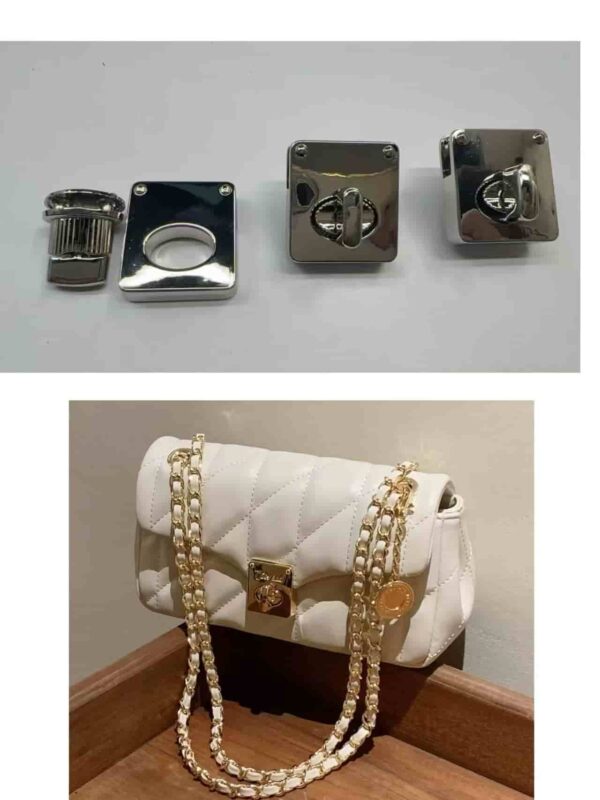
The core process for zinc alloys is die-casting. This involves injecting molten metal at high speed and under high pressure into precision steel moulds, where it cools and takes shape. This process confers unrivalled advantages upon zinc alloys: it enables the production of components with extremely complex shapes and intricate details in a single die-casting operation. Whether three-dimensional brand logos, elaborate floral reliefs or minute gear structures, they can be ‘reproduced’ with sharp edges and smooth surfaces, often without the need for extensive subsequent polishing. As industry observers have noted, zinc alloys possess excellent casting properties, enabling the die-casting of complex, thin-walled precision components with smooth surfaces.
Iron (Steel): The Art of Stamping and Cost Control
In the context of handbag hardware, the term ‘iron’ strictly refers to low-carbon steel or ordinary carbon structural steel. Its composition consists primarily of iron and carbon, along with small amounts of impurities such as manganese, silicon, sulphur and phosphorus.
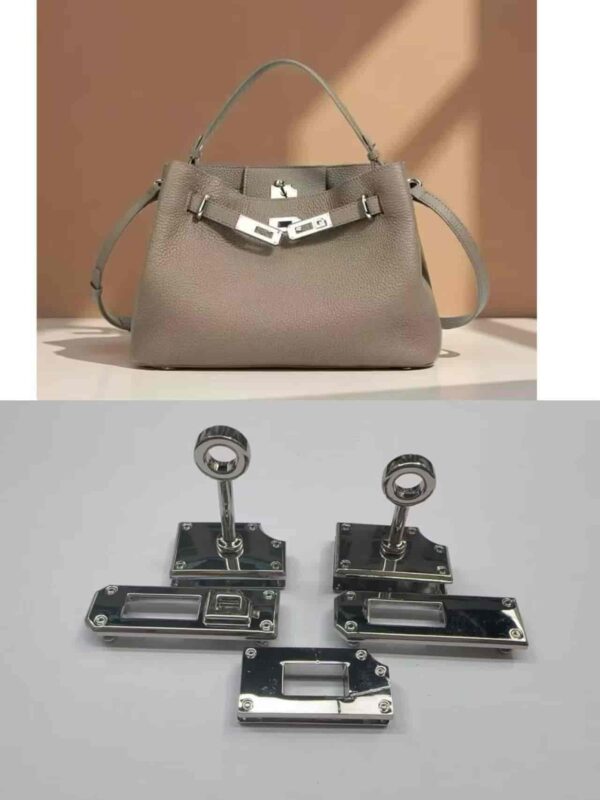
The primary manufacturing processes for iron are stamping and casting. For simple geometric shapes (such as D-rings and square buckles), the stamping process is typically employed, whereby steel sheets are punched, bent and formed within dies. Whilst this process is highly efficient, it has an inherent limitation: it is difficult to produce complex, intricate three-dimensional patterns. The level of detail in stamped parts depends on the precision of the die, and burrs often form on the edges, requiring additional deburring and polishing processes. This is why the vast majority of exquisite brand emblems and three-dimensional decorative fasteners are made from zinc alloy rather than iron.
2.Weight & Hand Feel – Does It Feel “Premium”?
When we pick up a handbag, the weight of the metal fittings is transmitted to our brain via the handle or shoulder strap, forming our first impression. This sensation is extremely subtle, yet crucial.
Zinc Alloy: Just the Right ‘Heft’
Zinc alloy has a density of approximately 6.3–6.7 g/cm³, which is lighter than pure iron (around 7.8 g/cm³) but considerably heavier than plastic or aluminium. This ‘medium’ weight is, in fact, an advantage when it comes to handbag hardware. It lends a handbag just the right ‘sense of substance’, allowing consumers to feel the quality and solidity of the metal when picking up the bag, without it feeling cumbersome due to excessive weight. In a medium-sized handbag fitted with a zinc alloy clasp, the weight of the hardware perfectly counterbalances the bag’s light, airy feel, creating an intuitive sense of ‘luxury’. Many retailers also emphasise ‘luxurious, lightweight and beautifully curved’ in their product promotions, confirming this balance between texture and weight.
Iron: The Dual Impression of Heaviness and Affordability
Iron fittings, by contrast, appear far ‘heavier’. For the same volume, iron is approximately 15–20 per cent heavier than zinc alloy. When used in large rucksacks or tool kits requiring the utmost durability, this extra weight conveys a sense of engineering that is ‘sturdy, durable and uncompromising’. However, when this sense of heaviness is applied to an elegant handbag or a compact crossbody bag, the result is often disastrous: the bag will sag and lose its shape due to the excessive weight of the fittings, whilst the shoulder strap will constantly slip off the shoulder because the fastenings are too heavy. Far from conveying a sense of luxury, this ‘unreasonable’ weight is instead interpreted by consumers as ‘clunky’ and ‘user-unfriendly’, giving off an air of cheapness.
For fashion handbags? Zinc alloy wins, hands down.
3.Rust – The Real Deal Breaker
This is where most people get into trouble.
Zinc alloy – naturally rust-resistant.
Because zinc doesn’t react with moisture the way iron does.
You don’t even need plating for daily use (though we usually plate it with gold, nickel, or matte black for looks).
Iron – rusts like crazy.
Pure iron has to be plated or painted. And here’s the scary part: if the plating cracks after 6 months, sweat or rain gets in, and soon you’ll see red rust bleeding onto your beautiful leather.
Worse – rust expands, so it cracks the plating even more.
If your customers live anywhere humid or coastal, seriously – pick zinc alloy or stainless steel. Don’t gamble with raw iron.
| Characteristic dimensions | Zinc alloy fittings | Iron (steel) fittings |
| Composition of Materials | Zinc-based, with the addition of aluminium, copper, magnesium and other elements (e.g. the Zamak series) | Low-carbon steel or ordinary carbon steel, consisting mainly of iron and carbon |
| Core Processes | Die-casting, suitable for complex and intricate designs | Stamping, suitable for simple geometric shapes |
| Weight and feel | It is of moderate weight, offering a solid ‘heavy-feeling’ without being cumbersome | Heavy, which can cause small handbags to lose their balance and slip off; they look bulky |
| Fatal flaw | Internal ageing, deformation and creep may lead to brittle fracture after several years | Once the surface plating is damaged, it is highly susceptible to rust, and the rust stains will stain the leather |
| Strength characteristics | It is very hard but brittle; when subjected to impact, it breaks rather than bends. | It has good toughness; it bends and deforms under overload rather than breaking suddenly. |
| Cost Breakdown | Moulds are expensive, and the cost of raw materials per unit is slightly higher; this is suitable for mass production. | Mould costs are low, as are raw material costs, but high-quality electroplating is quite expensive. |
4.Surface Finish & Plating – Who Looks Better Longer?
Zinc alloy takes electroplating beautifully.
Because the surface is smooth from die-casting, the plating (18K gold, chrome, antique brass) sticks evenly.
And shiny highlights? They stay looking great.
Iron – trickier to plate well.
You often need a copper layer first, then the final plating.
But on stamped iron, the edges usually get less plating thickness. Result? Edge rust within months.
So if you want intricate vintage designs or a super sharp logo, zinc alloy is your friend.
If you just need simple D-rings or plain thick buckles? Iron is okay.
5.Strength & Durability – Which One Breaks?
Strength and durability are central to the functionality of hardware components. In this regard, zinc alloy and iron follow entirely different technical paths.
Zinc alloy: hard, yet as brittle as glass
The advantages of zinc alloy are its hardness and surface wear resistance, coupled with excellent mechanical properties at room temperature. This means it is not easily scratched and retains an outstanding lustre. However, this hardness comes at the cost of brittleness. Zinc alloy has very poor ductility and virtually no malleability. When the stress exerted on it exceeds its breaking point, it gives no warning but simply shatters or breaks, just like a piece of glass. For example, if a zinc alloy clasp is accidentally dropped onto a concrete floor, a piece is likely to chip off from one of its corners, or it may simply crack.
Iron: Soft, yet as tough as taffy
The strength of iron lies not in its ‘hardness’, but in its toughness. Whilst it possesses a higher tensile strength, what is even more important is its excellent plasticity and ductility. When an iron component is subjected to excessive loads, it will first bend and deform rather than fracture immediately. This ‘yielding’ characteristic serves as a valuable early-warning mechanism for failure in engineering. It gives the user a clear signal that ‘I’m nearly at my limit’, rather than failing suddenly without warning, as is the case with zinc alloys.
Given this characteristic, the choice becomes very clear: for components subjected to immense tensile forces—such as the load-bearing buckles on rucksacks or the frame hinges on large medical bags—the ductility of iron provides unrivalled safety. Conversely, for decorative components such as clasps, nameplates and zip pullers—which are not subject to strong impacts—zinc alloy prevails due to its exquisite detailing and texture.
Quick rule of thumb:
Zinc alloy for: decorative plaques, twist locks, magnetic snaps, zipper pulls, corner protectors.
Iron for: heavy-duty roller buckles, large frame hinges (think doctor bags), or cheap utility bags.
6.Cost – not as Simple as You Think
Zinc alloy – moderate part cost.
The upfront mold cost is higher (roughly 300–300–1000 per mold).
But once you run 5,000+ pieces, the per-unit price gets really low.
Iron – low part cost.
Stamping molds are cheaper. But here’s the kicker: iron needs more expensive plating (multiple layers) to stop rust.
So in the end, the price difference isn’t as huge as you’d expect.
Small MOQ (100–1,000 pcs)? Iron might save you money.
Large scale (5,000+ pcs)? Zinc alloy usually gives better value – because it lasts longer and you won’t get rust complaints.
Quick Comparison Table (Easy to Scan)
| Feature | Zinc Alloy | Iron |
| Weight | Moderate (lighter) | Heavy |
| Rust resistance | Excellent | Poor (needs heavy plating) |
| Detail level | High (sharp logos) | Low (simple shapes only) |
| Strength type | Hard but brittle | Soft but tough |
| Best for | Luxury, fashion, logos | Utility, industrial, budget |
| Plating stays? | Yes, very well | So-so (edges wear first) |
Summary: Zinc Alloy vs. Iron – Which One Should You Pick?
Here’s the bottom line – choosing bag hardware doesn’t have to be complicated. Let me break it down for you:
Pick Zinc Alloy if:
- Your hardware needs a brand logo on it
- You want no rust issues (and fewer customer complaints)
- You’re making fashion or mid-to-high end bags
- The design has curves or complex shapes
Pick Iron if:
- You need heavy load-bearing strength (think big backpacks)
- The design is super simple (plain D-rings or square buckles)
- You’re on a tight budget (under $0.20 per piece)
- The bag will only be used indoors, in dry conditions
One sentence to remember:
Zinc alloy gives you details, rust resistance, and a premium feel. Iron gives you strength and low cost – but comes with rust risks.
My honest advice? Go with zinc alloy about 80% of the time. Yes, the mold costs a bit more upfront. But fewer returns and better brand reputation? That’s worth every penny.
Need samples of zinc alloy bag hardware? Hit me up. Free design consultation and mold quotes available.