Manufacturing Process of Luggage Hardware Hooks and Buckles: A Journey of Precision from Raw Materials to Finished Products
A seemingly simple bag hardware hook and buckle, in its product process, embodies multiple precise manufacturing techniques. Its life cycle begins with molten metal and eventually forms a polished, durable and fully functional finished product. Below, we will delve into its production process through six core stages.
Materials Science and Mould Engineering
Precision manufacturing begins with meticulous control over materials and moulds. Just as a building requires a solid foundation, so too are the durability and texture of snap fasteners established in this way.
The Art of Material Selection: Walking the Tightrope Between Performance and Aesthetics
The requirements for materials used in handbag hardware are almost exacting—they must possess sufficient strength to withstand the daily wear and tear, good fluidity to fill the intricate details of precision moulds, whilst also balancing lightness with corrosion resistance.
Zinc alloy: This is currently the most widely used material for handbag clasps, particularly No. 3 zinc alloy. It offers excellent die-casting properties, a low melting point (approximately 380–400 °C) and good fluidity, enabling the precise reproduction of intricate logos or textures from the mould. More importantly, it combines good strength and toughness with relatively manageable costs, making it a prime example of balancing performance and cost. Numerous mid- to high-end brands widely adopt zinc alloy as the base material for clasp bodies to ensure moulding precision even with complex structures.
Copper alloys (such as brass): Brass is the material of choice when seeking a more refined texture and greater strength. It has a denser texture, and its colour becomes particularly deep and rich following surface treatment; it is commonly used by top luxury brands to emphasise their vintage or opulent aesthetic.
Stainless steel: Primarily used in core functional components such as springs and rivets. Its excellent modulus of elasticity and fatigue resistance are fundamental to ensuring that the hook-and-loop fasteners open and close smoothly and have a long service life.
It is worth noting that rigorous quality control begins right at the source. Reputable manufacturers carry out spectral analysis on every batch of metal ingots entering their premises to test for levels of harmful impurities such as lead and cadmium, thereby preventing the finished products from becoming brittle or the plating from blistering as a result of using recycled materials.
The Soul of the Mould: The Microscopic Battlefield of Steel and Mirror Surfaces
The mould serves as the ‘master’ for the hook-and-loop fastener, and its precision directly determines the tolerance grade of the finished product.
Precision machining: Modern moulds are made from high-strength mould steel and are shaped using five-axis CNC (computer numerical control) milling machines. For undercuts or complex surfaces on hooks and clasps, electrical discharge machining (EDM) may even be required to compensate for electrode wear, ensuring dimensional accuracy to the micrometre level.
Mirror polishing: The mould cavity must undergo rigorous mirror polishing. This is not only to ensure that the hook fastener has a high gloss finish upon ejection from the mould, but also to allow the molten metal to flow smoothly during high-pressure die-casting, thereby preventing defects such as cold shuts or flow marks. The production cycle for a hook fastener mould typically takes between 7 and 15 days, including repeated trial moulding and trimming.
Die Casting: Shaping the Form
Die casting is the foundational process that gives the hook its basic shape, determining its inherent quality and initial contour.
In raw material melting, manufacturers heat metal raw materials such as zinc alloys or copper alloys in a furnace to a molten state at 400-500°C, preparing them to fill the mold.
Mold Precision: The mold serves as the “negative form” for the hook-and-loop fastener. We craft it from high-grade mold steel through CNC precision machining, and we polish its interior to a mirror finish.This ensures consistent shape for thousands of fasteners.
High-Pressure Injection and Molding: High-pressure injection and molding.Manufacturers forcibly inject molten metal at high speed and high pressure into the mold cavity. It then subcools under hundreds of atmospheres within a fraction of a second, where it cools and solidifies, producing the blank of the hook-and-loop fastener.
Quality Core: The critical focus here lies in controlling pressure and temperature to ensure a dense, defect-free internal structure. This constitutes the first quality barrier guaranteeing the fastener’s ability to withstand daily opening, closing, and tensile forces.
Spring and Pin Selection: The Soul’s Implantation
Springs and pins form the functional core of the hook-and-loop fastener, directly determining its opening and closing feel, smoothness, and service life.
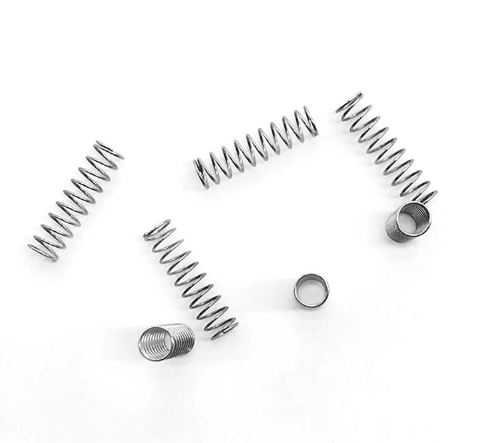
Springs—The Source of Power
- We strictly control the size error of the pins within an extremely small range to ensure flexible and safe integration with the hook body’s hole diameter.
- Durability test: High-quality stainless steel springs undergo tens of thousands of opening/closing tests to ensure consistent performance throughout the entire service life of the suitcase.
Pins—The Hub of Connection
- Precision Manufacturing: The sizes of the aperture in the hook body allow for extremely stringent tolerances for pin sizes and enable them to flexibly and securely slide into the opening with almost no gap or shaking space..
- For reinforcement, manufacturers use hardened-carburizing or carburized-hardening on pins. This creates a hardened, wear-resistant outer shell while keeping the interior tough. This “hard outside, soft inside” design significantly reduces bending and breaking risks.
Assembly process of Luggage Hardware hooks: A Precision Dance
Assembly is a crucial step in combining individual components into a fully functional hardware unit, aiming for the unity of efficiency and precision..Assembly is a crucial step in combining individual parts into a fully functional hardware unit, aiming to achieve a unity of efficiency and quality accuracy.
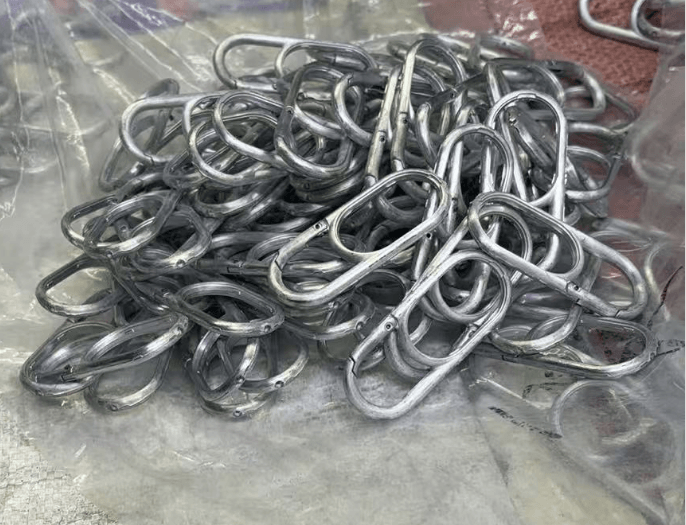
- Highly Automated: Modern factories widely utilize vibratory feeders, robotic arms, and automated assembly lines to achieve rapid, precise pressing of springs, pins, and die-cast bodies.
- For process control, we monitor parameters such as pressure and positioning in real time during assembly to ensure consistent and reliable quality for each hook-ring assembly.
- Retain traditional craftsmanship: For high-end or particularly complex hardware fasteners, experienced technicians still perform manual installation to address complex details that machines cannot handle, making sure perfect quality.
Polishing and Deburring process of luggage Hardware hooks: Refining the Surface
This process eliminates the rough surfaces and burrs produced by die-casting and mechanical processing, creating the perfect raw material for the subsequent electroplating
Polishing
Place the hooks and buckles with specific abrasives and tumble them into a polishing barrel along
Through prolonged physical friction, can remove the surface oxidation layers, scratches, and other imperfections, achieving a smooth, uniform matte or glossy finish.
Deburring
Traditional Method: Manually remove parting lines, flash, and sharp edges using files, sandpaper, etc.
Modern Process: Employ efficient techniques like electrolytic deburring and magnetic grinding. Magnetic grinding, in particular, utilizes magnetic fields to drive stainless steel needles, enabling thorough polishing of complex crevices and internal holes without dead zones.
Electroplating: The Final Barrier and Finishing Touch
The final step – electroplating, gives a hook and ring fastener a fine shiny look, making it not only visually appealing, but strong and resistant, as well. In this way, we combine aesthetic features with the necessary protective properties.
Core Purpose
- Anti-corrosion and Wear Resistance:It creates a strong metal film that prevents oxidation, rust, and wear during routine use.
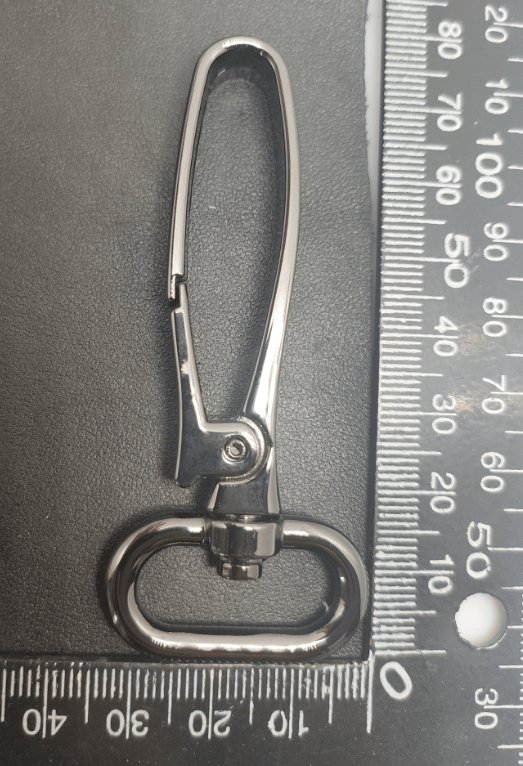
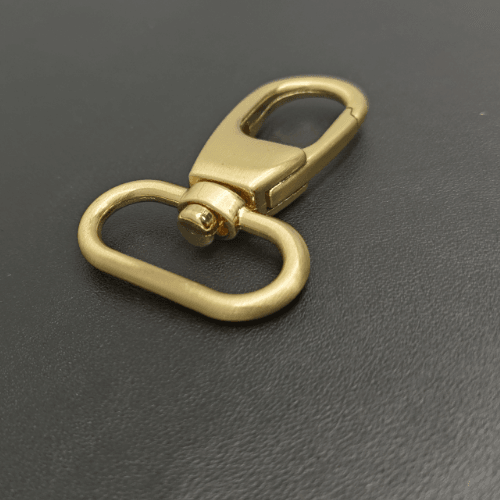
- Aesthetic Enhancement: It comes in various colors like nickel, gold, and black to suit different luggage designs and preferences.
Process and Procedure
We place the hook (cathode) into an electroplating solution containing metal ions. By controlling current, temperature, and time, we deposit plating ions evenly onto the surface, achieving a precise thickness. For specific colors like black, we add a post-plating spray painting step to prevent discoloration. It has to meet such uniformity, adhesion, and thickness requirements as specified. The upstream process-related imperfections become more pronounced after plating. Therefore, the plating is the ultimate quality criterion for the whole upstream production process.
Conclusion
In conclusion, making luggage hardware hooks and buckles is a well-tuned, high-precision industrial process. Everything goes from an extremely solid base – die-casting. The molten metal gets squeezed into the desired component form, which becomes alive thanks to springs and pins. The components housing the springs and pins are manufactured with high precision and such accuracy that no component can prevent integration with the assembly. After that, the parts are polished and deburred. This part of the process makes sure the surface quality of the hardware is maximized and imperfections are removed. . All these stages reflect the focus of the industry on quality, longevity, and aesthetics.