Essential Reading for Luggage Hardware Procurement: A Comparison of Styles, Materials and Manufacturing Processes for D-rings, Snap Fasteners and Dog Clasps
Bag and Luggage hardware components serve a dual purpose in finished bags, providing both functional fastening and aesthetic decoration. When selecting and procuring these items, there are significant differences in material, surface finish and structural strength across categories such as D-rings, square buckles, dog clips, snap fasteners, magnetic clasps, rivets, corner protectors and labels. This article outlines common selection criteria and technical comparisons for luggage hardware from the perspectives of practical factory procurement and designer selection, serving as a reference for B2B procurement professionals.
D-rings and square buckles: Key considerations when selecting load-bearing hardware
D-rings and square buckles are crucial load-bearing components used to attach shoulder straps, back straps and handles to luggage, handbags, pet carriers and outdoor bags. When selecting these components, it is essential to consider the type of opening, wall thickness and material hardness.
Classification of D-rings by Structure
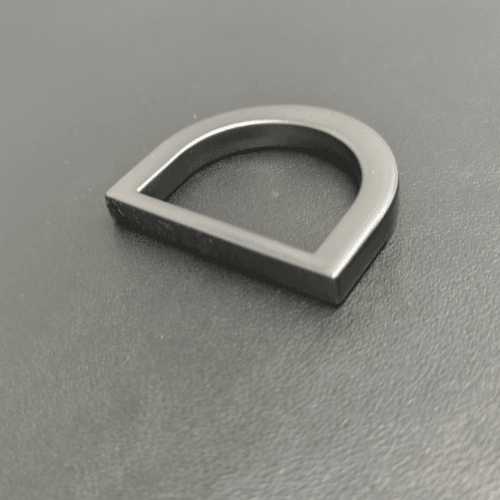
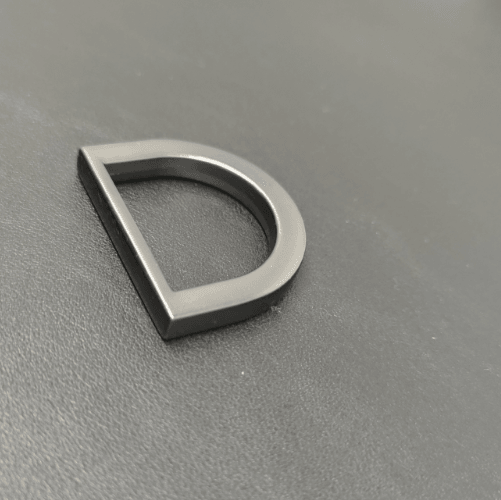
Their ‘D’-shaped appearance gives D-rings their name, and they commonly appear on the side loops of rucksacks and at the connection points of ladies’ handbag shoulder straps
- Wire D-rings: Formed by bending round or square metal wire, these are suitable for light to medium-weight bags, such as everyday handbags and casual rucksacks.
- Cast D-rings: Cast from zinc alloy or brass using moulds, these feature a dense structure and offer greater load-bearing capacity than wire D-rings. Manufacturers use them in briefcases, laptop bags, and heavy-duty outdoor rucksacks
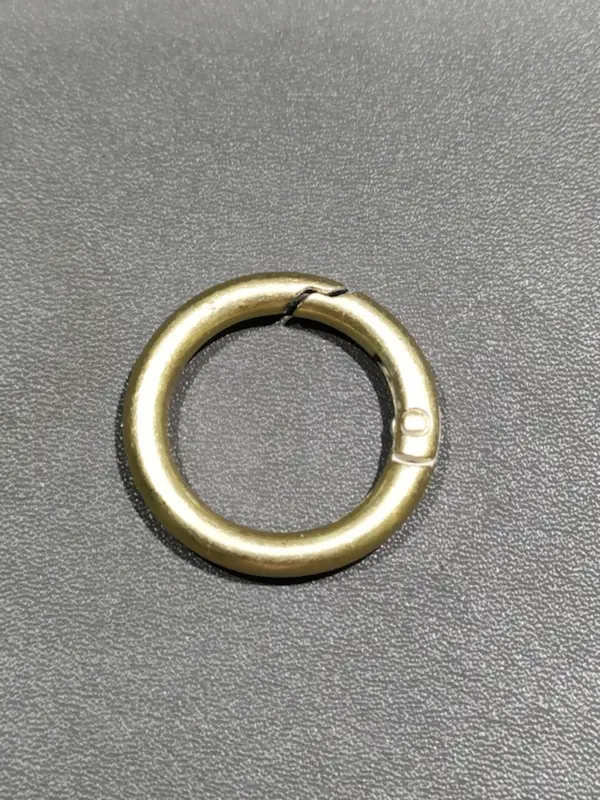
- Open-ended D-rings feature a spring or screw mechanism that facilitates the threading of webbing, while manufacturers must pre-fit closed D-rings during the bag manufacturing process because they are fixed
 |  |
Applications of Square Buckles
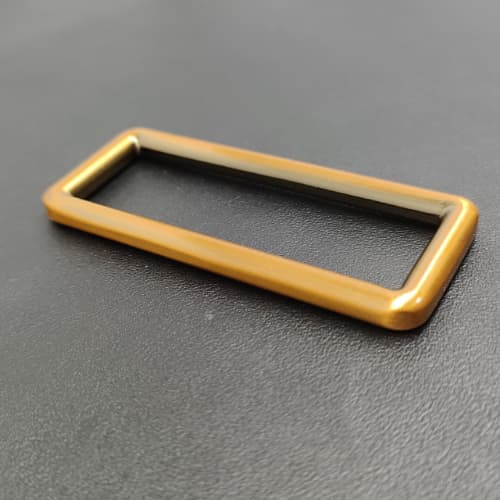
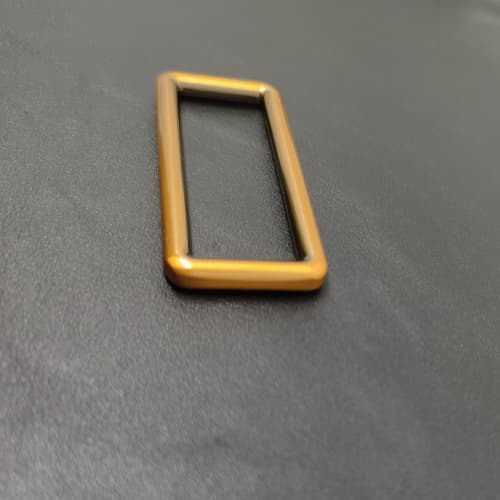
Manufacturers commonly use square buckles in webbing adjustment mechanisms and frequently find them on rucksack straps, pet carrier chest straps, and outdoor bag drawstrings.
- T-shaped buckle: Adjusts the length of the webbing and distributes force evenly.
- Eyelet buckle: Features a multi-hole design, suitable for multi-stage adjustment requirements.
- A square buckle with a mounting foot has a fixed foot at its base, and workers must secure it to the bag body using rivets or stitching.
 |  |
Material Selection Comparison
| material | Strength | Weight | corrosion-resistant | Suitable scenarios |
|---|---|---|---|---|
| Zinc alloy | Upper secondary | quite heavy | good | Locks for mid- to high-end women’s handbags and briefcases; cast D-rings |
| Iron | High | heavy | Generally | Requires electroplating or spray coating; suitable for tool kits and heavy-duty luggage |
| Brass | High | heavy | Excellent | Retro-style bags, high-end outdoor bags |
| Environmentally friendly alloy | Intermediate | lighter | good | Export orders, ROHS-compliant batches |
Purchasing advice: When selecting D-rings and square rings, prioritise checking the wall thickness or wire diameter specifications; standard zinc alloy castings should have a wall thickness of no less than 2 mm; for iron components, verify the thickness of the electroplated coating to ensure they pass the salt spray test.
Dog clip (hook clip): Key specifications for quick-release fasteners
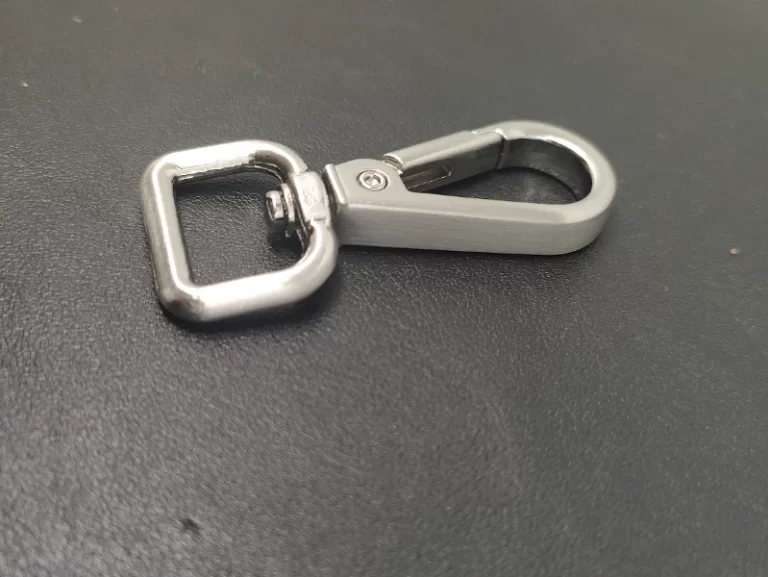
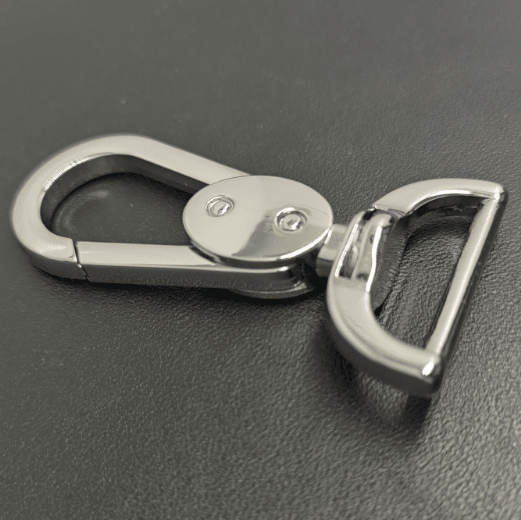
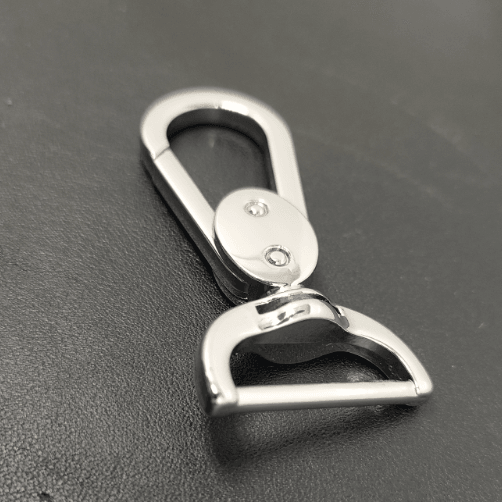
People also use dog clips, also known as spring clips or lobster clips, for pet leads, key rings, and similar items, in addition to their function of quickly attaching and detaching straps to the main body of a bag
Classification of Buckle Structures
- A built-in spring pushes the gate of a spring-loaded buckle back into place, making the buckle easy to operate and suitable for shoulder straps that users frequently detach.
- Swivel buckle: The connector can rotate 360 degrees, preventing the webbing from becoming tangled.
- Double-spring buckle: Featuring a double-spring mechanism, it offers greater reliability than a single-spring design.
 |  |
Key Procurement Considerations
- Spring lifespan: High-quality carabiner springs should withstand over 5,000 opening and closing cycles; when purchasing from standard manufacturers, you may request that samples undergo opening and closing tests.
- Gate Clearance: The gate should fit snugly against the buckle body when closed, with no wobble when pressed. Excessive clearance can lead to the webbing coming loose.
- Buckle Body Deformation Resistance: Zinc alloy dog buckles are cast as a single piece, offering superior resistance to lateral forces compared to stamped sheet metal parts. For high-stress applications, zinc alloy or brass materials are recommended.
Common Defects and How to Avoid Them
Spring Jamming: Caused by internal burrs or poor-quality spring material; commonly found in low-cost stamped latches.
Plating Peeling: Due to repeated friction on the moving parts of the gate; insufficient adhesion of the plating layer can lead to the base material becoming exposed.
Casting defects or excessively brittle material cause hook tip fracture. Manufacturers should carry out salt spray and tensile strength tests on a random basis
Snap fasteners and magnetic closures: the logic behind choosing a closure system
The closure system of a bag directly affects the user experience and security; snap fasteners and magnetic closures are the two main options
 |  |
Luggage fasteners
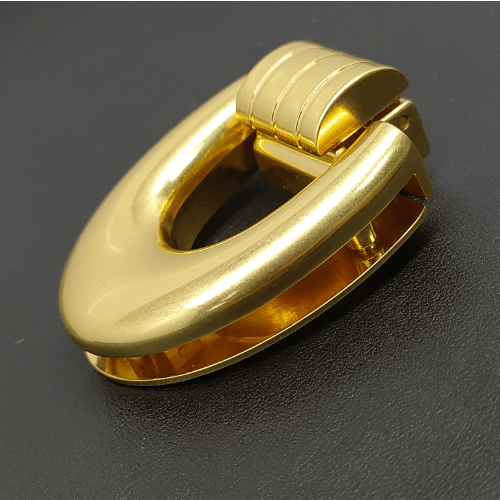
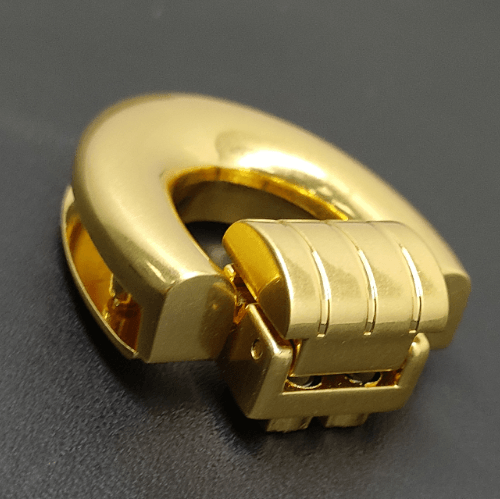
These fasteners feature a mechanical locking mechanism and are suitable for briefcases, vintage ladies’ handbags, and the bases of travel luggage.
Classified by structure
- Twist lock: A user engages a twist lock by rotating the lock cylinder, and manufacturers commonly find this lock on briefcases
- Push-button lock: Unlocked by pressing a button; quick to operate; often used as a secondary lock on zipped bags.
- Slide lock: Locked by sliding a tab; simple in design; used on lightweight handbags.
Purchasing advice: The key components of a snap fastener are the lock cylinder and the spring plate; prolonged use can lead to spring fatigue or wear on the locking tongue, causing the fastener to become loose. Before placing a bulk order, test the smoothness of opening and closing, as well as the play when locked. Zinc alloy lock casings offer superior strength to those made from folded sheet metal.
Magnetic fastener
Magnetic fasteners close using magnetic force, are easy to use, and are widely used on women’s handbags, clutches and the flaps of leather goods.
Categories:
Concealed magnetic fasteners: Remain hidden after installation, maintaining the clean appearance of the leather surface.
Decorative magnetic fasteners: Combine a magnetic mechanism with decorative components, offering both functionality and aesthetic appeal.
Dual magnets: Two magnets attract each other, providing stronger holding power; used for larger flaps.
Key Selection Criteria:
- Magnetic force should be moderate; if too strong, the clasp will be difficult to open; if too weak, it may spring open unintentionally.
- Anti-corrosion requirements: Both the magnets themselves and the plating must pass salt spray testing; for export orders, particular attention should be paid to eco-friendly plating.
- Avoid close contact with IC cards and electronic devices; inform downstream brand manufacturers when selecting products in bulk.
Eyelets, rivets and corner protectors: essential hardware that should not be overlooked
Although these small hardware components may seem inconspicuous, they significantly affect the durability and overall finish of a bag.
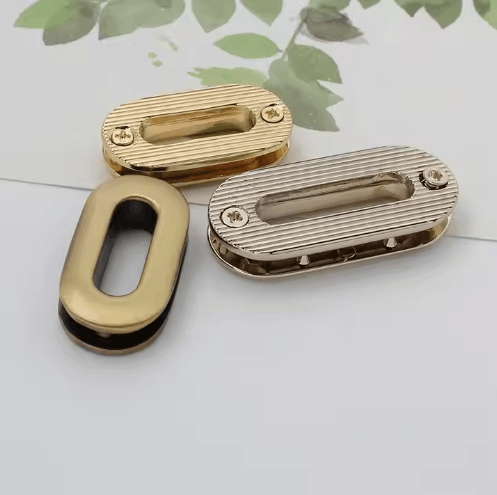
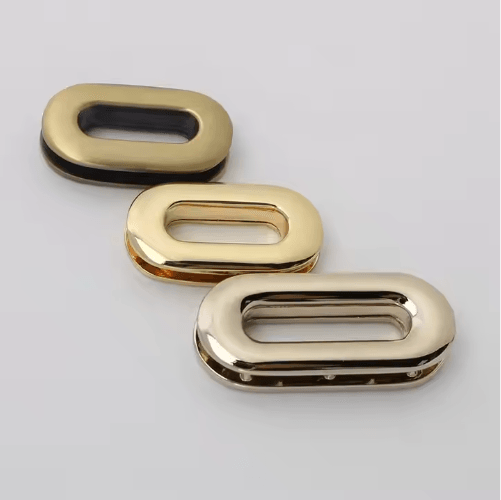
Eyelets
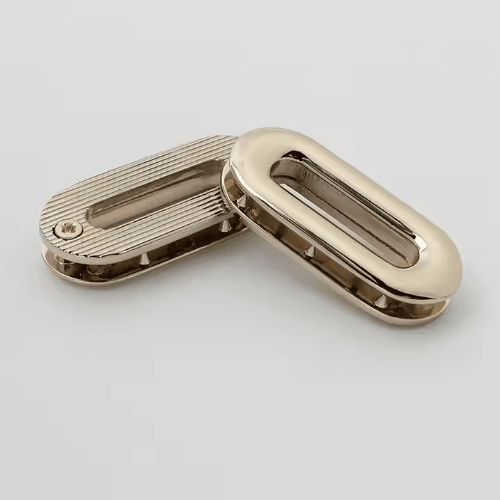
Used for punching holes for lacing, ventilation and decoration.
- The material and wall thickness determine whether the eyelet will deform after riveting; thin-walled eyelets are prone to cracking during stamping.
- Procurement requires sample testing to check that the flange is even and free from cracks.
 |  |  |
Rivets
Used to join multiple layers of material or secure metal fittings.
- Hollow rivets: Lightweight, suitable for joining leather and fabric.
- Solid rivets: High strength, used in areas subject to stress.
- Blind rivets: Can be customised with a logo on the surface; quick to install; used in denim and canvas bags.
Purchasing advice: Ensure the rivet length matches the thickness of the material; rivets that are too long or too short will compromise the strength of the joint.
Corner protectors
Fitted to the four corners of the base of luggage and bags to provide wear resistance and protection.
- Zinc alloy corner protectors offer excellent impact resistance and can be finished with processes such as brushed, black gold plating or antique bronze.
- The curvature of the corner protectors must match the base of the luggage; please provide the dimensions or a 3D diagram of the bag design prior to ordering
Luggage tags and custom-logo hardware
These serve as the brand’s visual identity and directly influence the perceived quality of the finished bag
Production Methods
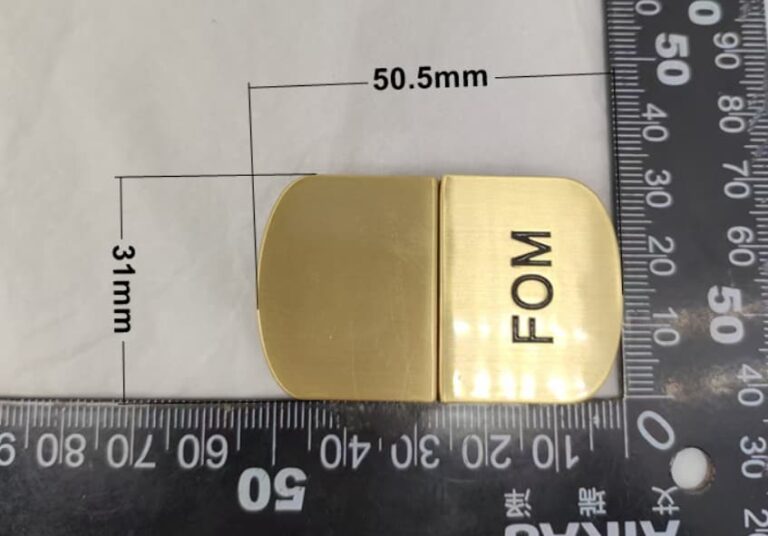
- Stamped badges: Mould-stamped with raised or recessed logos; moderately priced.
- Etched badges: Designs created through chemical etching; suitable for intricate patterns.
- Cast badges: Cast from zinc alloy or brass; highly three-dimensional; suitable for premium brands.
- Screen-printed or UV-printed badges: Colour logos printed onto flat badges; commonly used on fashion and casual bags.
Customisation Process
Provide design drawings or samples → Evaluate manufacturing processes and moulding solutions → Confirm materials and surface finishes → Produce prototypes → Approve prototypes → Mass production
VI. Comparison Table of Common Materials and Processes
Material
| Material | Features | Standard applications |
|---|---|---|
| zinc alloy | Can be cast into complex shapes with excellent surface finish | Snap fasteners, magnetic fastener casings, cast D-rings, nameplates |
| Iron | High strength, relatively low cost; requires anti-corrosion treatment | Eyelets, standard rivets, internal structural components |
| brass | Corrosion-resistant, with a fine texture and substantial weight | Vintage hardware, outdoor luggage fittings, high-end dog tags |
| Environmentally friendly alloy | Complies with RoHS standards; suitable for export | Hardware fittings for export orders to Europe and the US |
Surface treatment
| Process | Visual effect | Suitable scenarios |
|---|---|---|
| Electroplated nickel | High-gloss or matt silver | General-purpose hardware, with good corrosion resistance |
| Antique bronze | Deep copper with a vintage finish | Vintage bags and leather goods |
| Black Gold | Black background with gold accents or detailing | Fashionable women’s handbags, affordable luxury brands |
| Matt Black | Even black coating with strong adhesion | Outdoor bags, tool kits, high abrasion resistance required |
| Brushed | The metal surface exhibits a linear texture | Signs, D-rings, corner protectors, business luggage |
| spraying | Coloured or protective coating | Colour schemes for fashion bags and children’s bags |
| Hypoallergenic, eco-friendly electroplating | Low-nickel and nickel-free processes | Accessories that come into direct contact with the skin; ROHS-compliant orders for export |
Custom Moulding Process and Timeline
Custom luggage hardware accounts for a significant proportion of our B2B business. The standard process is as follows:
- Requirement Confirmation: Provide drawings, samples or reference images, and specify the materials, dimensions, surface finishes and functional requirements.
- Mould Quotation and Production: Mould costs and lead times are determined based on the complexity of the hardware; standard moulds typically take 7–15 days.
- Prototyping: Samples are produced using the mould for the purchaser to confirm dimensions, appearance and functionality.
- Sample Approval: The purchaser conducts functional testing, salt spray testing and tensile testing.
- Mass Production: Confirm production standards and packaging requirements for the bulk order.
- Dispatch and Inspection: Provide material certificates or environmental compliance reports (e.g. RoHS).
Procurement Reminder: Ownership of moulds, modification costs and maintenance responsibilities should be clearly stipulated in the contract. Conduct a small-batch trial production prior to mass production to confirm batch consistency.
Environmental Requirements for International Trade Orders
Bag and luggage hardware intended for international trade must comply with the environmental regulations of the importing country
- ROHS: Restricts lead, mercury, cadmium, hexavalent chromium, etc., applicable to the EU market.
- REACH: Controls substances of very high concern (SVHCs), applicable to the EU.
- Prop 65: California Proposition 65, applicable to the US market.
- Nickel Release Testing: Hardware intended for prolonged skin contact must comply with EN 1811 / EN 12472.
Hypoallergenic, eco-friendly plating processes can effectively reduce the risk of nickel release. When sourcing for export, the destination country and applicable testing standards must be clarified at the quotation stage.
Key Points to Avoid Pitfalls in Procurement of luggage hardware
Never place an order without seeing a sample: The appearance and feel of luggage hardware must be verified using a physical sample.
- Include test criteria in the contract: Salt spray test duration, tensile strength (in kilograms), and number of opening/closing cycles.
- Use reports to confirm materials: A verbal promise of ‘solid brass’ is no substitute for a material composition report.
- Keep records of mould condition: Retain inspection data for the first piece produced from both new moulds and reworked moulds.
Control colour variation between batches: Surface treatments may result in colour variations between batches; retain standard colour swatches for mass production.